What is the best deer feed for whitetails?
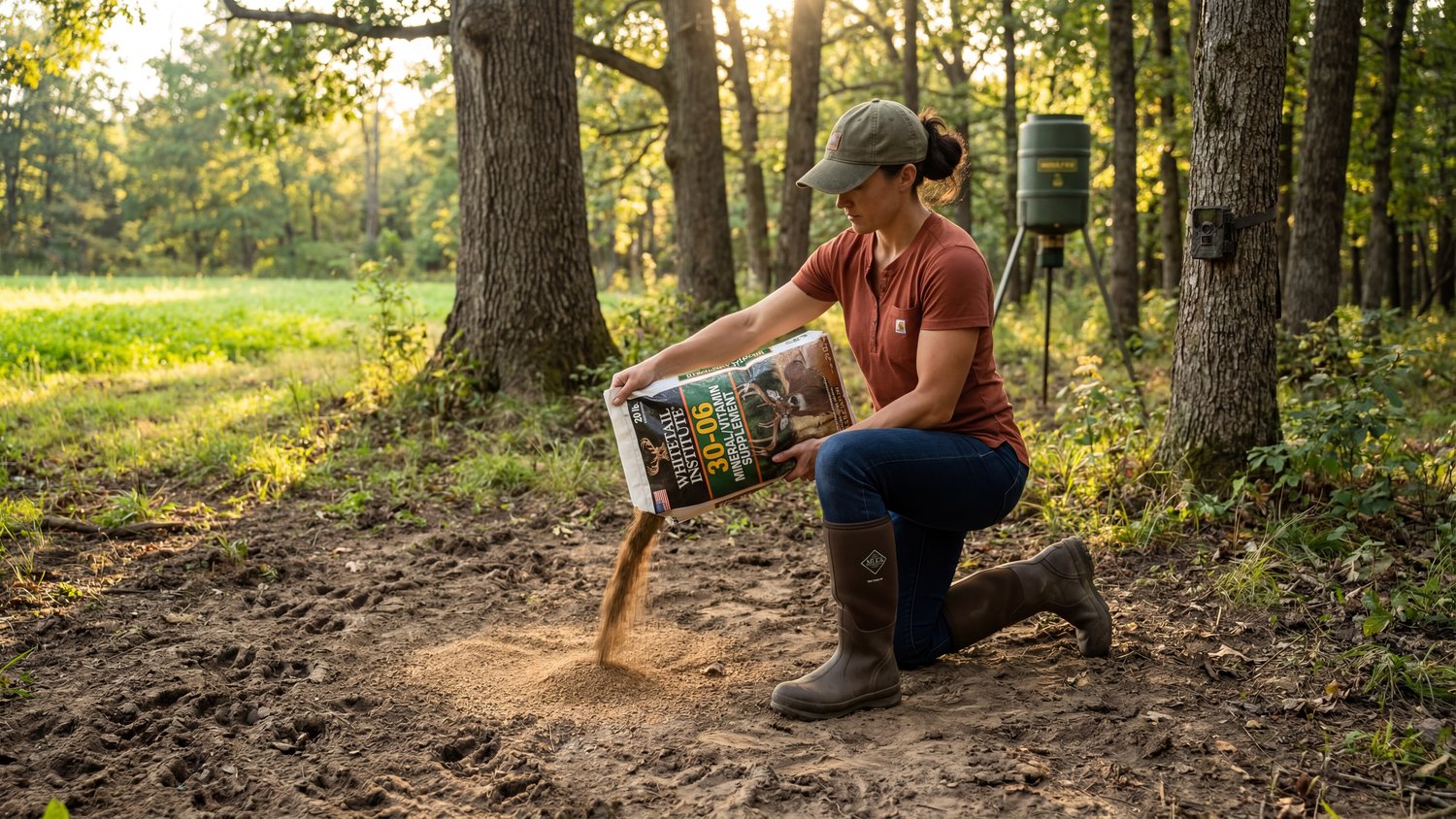
For supplemental feeding, Purina AntlerMax Deer 20 (~$25/50 lb bag) is the best research-backed option with 20% protein and patented mineral technology. For high-fat body condition support, Record Rack Golden Deer Nuggets ($7-15/40 lb, 12% fat — 3x corn) are the value play. For minerals, Whitetail Institute 30-06 delivers proven results for antler growth. Start with minerals — they cost less and are legal in more states.
What is the best deer feed for whitetails?
For supplemental feeding, Purina AntlerMax Deer 20 (~$25/50 lb bag) is the best research-backed option with 20% protein and patented mineral technology. For high-fat body condition support, Record Rack Golden Deer Nuggets ($7-15/40 lb, 12% fat — 3x corn) are the value play. For minerals, Whitetail Institute 30-06 delivers proven results for antler growth. Start with minerals — they cost less and are legal in more states.
Key Takeaways
- Minerals matter more than feed — start with a mineral site before buying bags of corn
- Corn alone is junk food for deer — it fills them up without the protein they need
- Gravity feeders beat spin-cast feeders for supplemental programs (less waste, fewer batteries)
- Place feed stations 100+ yards from stand locations to avoid spooking mature bucks
- Check your state regulations — baiting and feeding laws vary widely and change often
This article contains affiliate links. As an Amazon Associate I earn from qualifying purchases. I only recommend products I've personally used.
I've spent more money on deer feed and minerals than I care to admit. Bags of this, blocks of that, feeders that rusted out in two seasons. After 15+ years of trial and error on my own land, I've figured out what actually moves the needle for herd health and what's just expensive deer candy.
Here's the thing most marketing won't tell you: no bag of feed is going to fix bad habitat. But used correctly, the right supplemental feed, mineral program, and delivery system can absolutely improve antler growth, doe health, and keep deer on your property instead of your neighbor's.
Let me walk you through exactly what I run and why.
Quick Picks: Best Deer Feed at a Glance
- Best Overall Mineral: Whitetail Institute 30-06 (~$20-27/20 lb) — chelated minerals with vitamins A, D, E for maximum absorption
- Best Attractant: Evolved Habitats Deer Cane ($5-10/block) — creates self-sustaining lick sites
- Best High-Fat Feed: Record Rack Golden Deer Nuggets ($7-15/40 lb) — 12% fat, 3x more than corn
- Best Premium Feed: Purina AntlerMax Deer 20 (~$25/50 lb) — university-researched 20% protein formula
- Best Feeder: Boss Buck Gravity Feeder ($150-200) — raccoon-resistant HDPE, converts to automatic, lasts 5+ years
- Best Budget Feeder: Moultrie 30-Gallon Tripod ($125-170) — programmable timer, Quick-Lock assembly, easy solo setup
Feed vs. Mineral vs. Attractant — What's the Difference?
Before we get into specific products, let's clear up some confusion I see constantly. These three categories do different things, and mixing them up means you'll waste money solving the wrong problem.
Supplemental Feed
Supplemental feed is actual nutrition — protein, carbs, fat, and fiber. Think of it like putting out a meal. Deer corn is the most common (and most basic) example, but modern formulations include soybeans, alfalfa, grains, and proprietary blends designed to hit specific protein levels. Good supplemental feed targets 16-20% protein, which is well above what corn delivers at roughly 8-9%.
You run supplemental feed when natural browse is limited — late winter stress periods, drought, or on properties where the habitat simply can't support the deer density you have. On smaller parcels, this is even more critical — see our guide on deer management on small acreage.
Minerals
Minerals are micronutrient supplements. Calcium, phosphorus, sodium, zinc, manganese — the building blocks deer need for antler growth, bone density, fawn development, and overall health. Deer crave minerals naturally (that's why they hit natural salt licks), and providing a mineral site gives them access to nutrients that may be lacking in your soil and native forage.
Mineral programs are a long game. You won't see results in one season. Commit to 2-3 years minimum before judging whether it's working.
Attractants
Attractants are designed to draw deer to a specific spot. They might have some nutritional value, but their primary job is smell and taste appeal. Fruit-flavored blocks, liquid attractants, granular scents — these pull deer in for trail camera surveys, hunting setups, or to introduce them to a mineral/feed site.
Attractants are the gateway. They get deer to show up. Feed and minerals keep them coming back. Pair attractants with proper trail camera placement to monitor what's working.
Important Distinction
Many products blur the lines between these categories intentionally. A "mineral attractant" might be 90% salt and 10% trace minerals. Read the guaranteed analysis on the bag, not just the marketing claims on the front.
Legal Considerations — Read This First
I can't stress this enough: deer feeding and baiting laws vary wildly by state, and sometimes by county. What's perfectly legal on my property in one state could get you a hefty fine and license revocation in another.
Here's the general landscape:
- Some states ban all feeding and baiting year-round (common in CWD zones)
- Some states allow feeding but not hunting over feed (you can supplement, but the feed must be removed before season)
- Some states allow minerals year-round but restrict feed during season
- Some states have no restrictions at all
CWD (Chronic Wasting Disease) has changed the rules in many areas. Feeding stations concentrate deer, which can accelerate disease transmission. If your state or county has confirmed CWD cases, there may be emergency feeding bans in place that override normal regulations.
Check your state wildlife agency website before you put anything out. Laws change frequently, especially as CWD continues to spread. Ignorance is not a defense, and conservation officers have heard every excuse.
Product Reviews
1. Whitetail Institute 30-06 Mineral/Vitamin Supplement — Best Overall Mineral
Whitetail Institute 30-06 Mineral/Vitamin Supplement — 20 lb
~$20-27 per 20 lb block or granular. Contains vitamins A, D, E plus "Antler Up D3" for calcium/phosphorus uptake. Pre-scored block breaks into 4 pieces for multiple sites. 50+ bought monthly on Amazon.
Check Price on Amazon →This is what I run on every mineral site and have for years. The 30-06 formula includes calcium, phosphorus, and a full spectrum of chelated trace minerals plus vitamins A, D, and E. Chelated minerals matter because they're bonded to amino acids, which means deer actually absorb them instead of passing them through.
I pour it directly on the ground in a cleared area about 3 feet across. Within a week or two, deer find it. Within a month, they've cratered the ground down several inches. I refresh each site every 4-6 weeks during the spring and summer antler-growing season.
Pros:
- Research-backed formula from Whitetail Institute (they've been at this since the 1980s)
- Chelated minerals for better bioavailability
- Deer hit it hard — high attraction factor alongside real nutrition
- Weatherproof — rain activates it and pulls minerals into the soil
Cons:
- More expensive than Deer Cane or basic mineral blocks (~$20-27 vs $5-10)
- Regional variability — one user reported West-side deer wouldn't touch it while East-side deer loved it
- Not a year-round product — designed for spring/summer supplementation
- 20 lb block is heavy for transport to remote sites
2. Evolved Habitats Deer Cane — Best Attractant
Evolved Habitats Deer Cane — Block, Powder, or Liquid
$5-10 per block (4 lb), $8-12 per powder (6.5 lb). Minerals react with moisture to release vapors that attract deer. Also available in "Black Magic" (molasses) and "Co-Cane" (coconut) variants.
Check Price on Amazon →Deer Cane is one of those products that just works. I use the granular version to start new sites and the liquid to refresh existing ones. Pour it on the ground, and the mineral-salt combination creates a site that deer will visit for months.
Here's what I like about it: once deer start working a Deer Cane site, it becomes self-sustaining to a degree. The minerals soak into the soil, and deer keep coming back to lick the dirt long after the original product has dissolved. I have sites that are 5+ years old that deer still hit regularly.
Is it a complete mineral supplement? No. It's more attractant than supplement. But it's unbeatable for getting deer to commit to a location — in front of a trail camera, near a stand site, or as a starter to introduce deer to a more complete mineral program.
Pros:
- Excellent initial attraction — deer find it fast
- Creates long-lasting sites that deer revisit
- Affordable and widely available
- Both granular and liquid options for different situations
Cons:
- More attractant than true mineral supplement — mostly salt
- MUST be buried in soil and activated by water — many users skip this and get no results
- Highly regional — deer in some areas ignore it completely
- Blocks arrive broken in shipping (FedEx damage commonly reported)
- Liquid version criticized as "pouring water" — weak formulation
- Blocks can dissolve in a few weeks with no deer activity in some locations
3. Record Rack Golden Deer Nuggets — Best Supplemental Feed
Record Rack Golden Deer Nuggets — 40 lb, 13% Protein, 12% Fat
$7-15 per 40 lb bag. Advanced extrusion for water resistance. Wild berry flavor. Works in spin-cast feeders (2" minimum opening).
Check Price on Amazon →If I am running supplemental feed (and state law allows it), Golden Deer Nuggets are a strong option. At 13% protein and 12% fat — 3x the fat content of corn — they deliver real body-condition support for deer going into and coming out of winter. The nugget form means less waste — they do not blow away, they hold up in rain better than pellets, and deer cannot scatter them like loose corn. A popular Texas combination on TexasBowhunter forums is mixing 50/50 with Record Rack Sportsman 20 pellets for both protein and fat.
I've run these through gravity feeders and in trough-style setups. Deer take to them quickly, usually within a few days. The transition is faster if you mix them with corn initially, then gradually shift to straight nuggets over a couple of weeks.
Cost-wise, they're more expensive per pound than corn, but you're getting actual nutrition rather than basically feeding deer junk food. Think of corn as candy and nuggets as a real meal.
Pros:
- High protein content supports antler and body development
- Nugget form reduces waste compared to loose feeds
- Deer accept them readily, especially mixed with corn initially
- Works in gravity feeders without clogging
Cons:
- Higher cost per pound than corn or basic feeds
- Can attract non-target species (raccoons, hogs, squirrels)
- Still need proper feeder setup to avoid ground waste
4. Wildgame Innovations Persimmon Crush — Best Attractant Block
Wildgame Innovations Persimmon Crush — 5 lb
~$11-15 per 5 lb bag. 17% protein, 11.75% fat. "Airborne Technology" releases 600% more scent molecules than ordinary feed grains. Mix with corn for extended use.
Check Price on Amazon →I'm generally skeptical of flavored blocks, but Persimmon Crush actually delivers. Set it on the ground or on a stump, and the persimmon scent pulls deer in from a surprising distance. I've had trail camera hits within 48 hours of placing a new block.
The block format is dead simple — no mixing, no pouring, no equipment. Just place it and walk away. It dissolves slowly over several weeks, so you're not refreshing it constantly. In areas where I can't run a feeder or don't want to maintain a mineral site, these blocks are my lazy option. And sometimes lazy is exactly the right approach.
Don't expect this to be a nutritional game-changer. It's an attractant first. But it does contain some trace minerals, and the draw factor is legit.
Pros:
- Strong persimmon scent that deer respond to quickly
- Zero-maintenance — place it and forget it for weeks
- Compact, easy to carry to remote spots
- Good for trail camera surveys and scouting
Cons:
- Effectiveness varies if persimmon isn't native to your area — deer may not recognize the scent
- 5 lb bag goes fast when mixing with corn (popular ratio: half bag per 40 lb corn)
- Parent company Wildgame Innovations has 1.5/5 overall rating on PissedConsumer — mostly trail cam complaints, but brand reputation concern
- Not a standalone nutritional supplement — primarily an attractant despite decent protein/fat numbers
- Powder form can clump in humid conditions
5. Purina AntlerMax Deer Feed — Best Premium Feed
Purina AntlerMax Deer 20 — 50 lb, 20% Protein, Climate Guard
~$25/50 lb bag. WaterShield variant (~$26) resists rain better. Contains Bio-LG lemongrass extract. Apple-flavored.
Check Price on Amazon →At ~$25 per 50 lb bag, Purina AntlerMax Deer 20 is actually cheaper per pound than many competitors while delivering the highest protein (20%) on this list. Purina's wildlife division has actual research behind their formulations — university studies, controlled feeding trials, the whole deal. Climate Guard technology helps deer manage heat stress, and Bio-LG (lemongrass extract) supports intake and coat health.
AntlerMax uses a patented mineral technology that optimizes the calcium-to-phosphorus ratio (1.0-1.5% Ca, 1.0% P) for antler growth. Vitamin A at 11,000 IU/lb supports immune function. The WaterShield variant (~$26, ASIN B07F82XVMP) resists moisture better — worth the extra dollar if your feeders are exposed to rain. Long-time forum users on GON Forum report using it for 10+ years with consistent results.
I ran AntlerMax on one property for three consecutive years alongside a control property using standard feed. The AntlerMax property showed noticeably better body condition on does and improved antler mass on bucks. Was it solely the feed? Impossible to say for certain — habitat, genetics, and age structure all play roles. But it was a consistent enough difference that I kept buying it.
The pellet form works in any gravity feeder and holds up reasonably well in damp conditions.
Pros:
- Research-backed formula from a major feed company
- Patented mineral technology for antler development
- High digestibility — deer utilize more of the nutrition
- Consistent quality batch to batch
Cons:
- Low fat content (1.8%) vs Record Rack Golden Nuggets (12%) — less body condition support
- Tractor Supply reviews report grain beetles in some bags — inspect before pouring into feeders
- Some forum users on Arkansas Hunting report raccoons and hogs prefer it over deer
- Contains added copper — NOT safe for sheep if you run mixed livestock
- Designed as a supplement (Feb-Aug), not a complete year-round feed
6. Boss Buck Gravity Feeder — Best Feeder
Boss Buck Gravity Feeder
Roto-molded HDPE gravity feeder, $150-200. 3-way adjustable flow, lockable lid, converts to automatic with 12V kit add-on. Raccoon-resistant design.
Check Price on Amazon →I've gone through my share of cheap feeders. They rust, they clog, the legs bend, raccoons tear them apart. The Boss Buck was the first gravity feeder I bought that actually felt like it would last more than two seasons. And it has — multiple hunters on forums report 5+ years of continuous use.
The roto-molded HDPE construction is the key. It won't rot, rust, or leak like steel feeders. The UV-protected plastic sheds rain instead of collecting it, and the lockable lid keeps out curious hands (two- and four-legged). The 3-way adjustable flow control handles everything from small pellets to nuggets to corn without clogging — a problem that plagues cheaper gravity feeders.
The standout feature is Boss Buck's patented gravity-to-automatic conversion. Run it as a simple gravity feeder for spring and summer protein feeding, then add the 12V kit to convert it to timed dispensing for fall and winter. That dual-purpose design is unique and saves buying two feeders. The 10-inch feeder ports are angled at 10 degrees with a 1-inch overhang, forcing deer to feed slowly — which reduces waste and gives more deer a chance to eat.
Here's the honest catch: at $150-200, it costs more than a Moultrie tripod. But forum consensus strongly favors gravity feeders for attracting mature bucks — experienced hunters (30+ years) consistently report that big bucks simply don't use spin feeders but will readily use gravity feeders. If your goal is deer management and not just entertainment, that matters.
Pros:
- Roto-molded HDPE — won't rot, rust, or leak; 5+ year lifespan reported
- Raccoon-resistant design (unlike Moultrie tripods)
- Converts from gravity to automatic with 12V kit add-on
- 3-way adjustable flow for pellets, nuggets, or corn
- Mature bucks use gravity feeders more readily than spin feeders
Cons:
- $150-200 upfront — significant investment vs budget feeders
- Squirrels can chew through the HDPE plastic (reported on Amazon)
- Heavy when full — difficult to relocate once positioned
- Burns through feed fast — 300 lbs of corn disappears in 4-5 days with an active herd
- No timed dispensing unless you buy the 12V conversion kit separately
7. Moultrie 30-Gallon Tripod Feeder — Best Budget Feeder
Moultrie 30-Gallon Tripod Feeder
Budget tripod feeder, $125-170. 30-gal/200 lb capacity, Quick-Lock assembly, programmable digital timer with 4-10 feed times/day. Multiple models available including gravity-only option.
Check Price on Amazon →If you're testing the waters with supplemental feeding or running multiple sites on a budget, the Moultrie tripod feeder is the obvious starting point at $125-170. It's not going to win any durability awards, but for the price, it gets feed on the ground.
The Quick-Lock hopper system is genuinely useful — tool-free assembly means you can set it up solo in about 15 minutes. The 30-gallon hopper holds roughly 200 lbs of feed, and the programmable digital timer lets you set 4-10 feed times per day depending on the model. That controlled dispensing is useful for training deer to visit during daylight for trail camera placement or reducing overnight raccoon raids. A gravity-only configuration is also available if you want to skip batteries entirely.
I've run several of these as satellite feeders while using the Boss Buck as my main station. They typically last 2-3 seasons before problems start. At $125-170, that lifespan is acceptable — but you should know what you're getting into.
Pros:
- Budget-friendly at $125-170 — cheapest way to start a feeding program
- Quick-Lock tool-free assembly — one-person setup in 15 minutes
- Programmable timer controls feed consumption and cost
- Multiple models: spin, gravity, solar-compatible (6V external port)
- Feed-level estimator and battery indicator on newer models
Cons:
- Water leaks into battery housing — recurring problem across multiple models on Amazon
- Motor/spinner failures reported after just 1-2 months of use
- Missing bolts in kits — one Amazon reviewer reported 7 bolts short
- Hopper plastic is hard and brittle — breaks if knocked over by wind or animals
- NOT raccoon-proof — they chew holes right through the plastic
- Actual capacity less than advertised (~150 lbs vs stated 200+ lbs)
- May need shaking every 2-3 days to prevent clogging with pellet feed
Comparison Table
| Product | Category | Price | Best For |
|---|---|---|---|
| Evolved Habitats Deer Cane | Attractant | $5-10/block | Drawing deer to mineral sites |
| Persimmon Crush Block | Attractant | ~$11-15/5 lb | Scouting / trail cam sites |
| Record Rack Golden Nuggets | Feed (13% protein) | $7-15/40 lb | Budget supplemental feed |
| Whitetail Institute 30-06 | Mineral | ~$20-27/20 lb | Long-term herd health |
| Purina AntlerMax Deer 20 | Feed (20% protein) | ~$25/50 lb | Maximum nutrition / antler growth |
| Moultrie 30-Gal Tripod | Feeder | $125-170 | Budget / satellite feeding sites |
| Boss Buck Gravity Feeder | Feeder | $150-200 | Primary feeding station / mature bucks |
Seasonal Strategy: When to Use What
Dumping feed and minerals year-round with no plan is just burning money. Here's the seasonal approach I follow:
Late Winter (January - March)
This is the stress period. Natural browse is at its lowest, and deer are burning fat reserves just to survive. If you're going to run supplemental feed, this is when it matters most. High-protein feeds like Record Rack or AntlerMax help deer recover from the rut and get through the lean months. This is also the ideal window to plan your spring food plot plantings.
Don't start feeding in the middle of a harsh winter if you haven't been feeding. Deer that suddenly find a rich food source can develop digestive problems. Start your program in late fall and maintain it through winter.
Spring (April - June)
Minerals become the priority. Bucks are growing antlers, does are carrying or nursing fawns, and the demand for calcium and phosphorus spikes. Refresh your mineral sites with 30-06 or your preferred mineral. This is the most important window for mineral supplementation.
Attractants like Deer Cane can help establish new mineral sites during this period — deer are actively seeking minerals and will find new sites quickly.
Summer (July - September)
Continue minerals. Natural food is generally abundant, so supplemental feed is less critical unless you're in drought conditions. This is a good time to place attractant blocks near trail cameras for summer surveys — our camera mounting guide covers the best setup for mineral site monitoring. Inventory your herd, check on fawn recruitment, and see how your bucks are developing.
Fall (October - December)
Know your state laws inside and out for this period. Many states restrict or ban feeding and baiting during hunting season. If feeding is legal, maintain your program. If not, shut it down well before the required time window. Mineral sites are generally legal year-round in most states, but verify. Understanding how hunting pressure changes deer movement will help you time your feeding program around season activity.
Year-Round Rule
Whatever you start, don't stop abruptly. Deer pattern to feeding sites. If you run a feeder for three months and then abandon it, those deer lose a food source they've been relying on. Commit to a full year or don't start.
How to Set Up a Feeding / Mineral Station
Location matters more than the product you use. Here's how I set up both types of sites:
Mineral Site Setup
- Pick a spot with existing deer traffic. Near a trail junction, between bedding and feeding areas, or along a field edge. Don't put minerals where deer don't already travel.
- Clear a 3-4 foot circle down to bare dirt. Remove leaves, grass, and debris. You want mineral-to-soil contact.
- Pour the mineral directly on the ground. Don't use a container — deer need to lick the soil to get the minerals. Rain will wash the minerals into the dirt, creating a long-lasting site.
- Place a trail camera nearby. 10-15 feet away, chest height, facing north (avoids sun glare). Check our settings guide to reduce false triggers from wind-blown vegetation around the site.
- Refresh every 4-6 weeks during spring and summer. You'll see the crater deer have dug. Add more mineral to the center.
Feeder Setup
- Position the feeder in a semi-open area with good visibility for deer (they don't like feeding in spots where they can't see approaching danger) and with some cover nearby for them to approach through.
- Set it on level ground. An unlevel feeder won't dispense consistently and can tip in storms.
- Clear the ground beneath. Remove brush and debris so spilled feed doesn't rot and create a disease risk.
- Keep it at least 100 yards from your main stand locations. Hunting directly over a feeder (where legal) is generally poor practice for long-term deer management. The smart bucks will go nocturnal fast.
- Check and refill on a consistent schedule. Mid-day visits create less disturbance than morning or evening.
Common Mistakes
I've made all of these. Learn from my stupidity:
- Relying on corn as your primary feed. Corn is roughly 8-9% protein. Deer need 16-20% for optimal development. Corn is fine as a supplement or attractant, but it's nutritionally equivalent to feeding your family nothing but white bread. Use it to transition deer to better feeds, not as the main course.
- Starting a feeding program you can't sustain. Half-measures are worse than doing nothing. Deer that become dependent on supplemental feed and then lose it are in worse shape than deer that never had it. Budget for a full year before you start.
- Putting out minerals in the wrong season. Minerals during hunting season might be illegal in your state, and they're least beneficial in fall/winter anyway. The critical window is spring through mid-summer when antlers are growing and fawns are developing.
- Ignoring hygiene at feeding sites. Concentrated feeding means concentrated disease risk. Move your sites periodically, clean up old feed that's molded, and never use a site where you've seen visibly sick deer.
- Expecting instant results. Mineral programs take 2-3 years to show measurable herd improvement. Supplemental feeding helps condition, but it won't override bad genetics or poor age structure. This is a marathon, not a sprint.
- Placing feeders too close to roads or property lines. You're feeding your neighbor's hunting spots if deer are crossing boundaries to reach your feeder and getting shot on someone else's land. Keep feeding sites deep on your property — our food plot shape guide covers similar interior positioning principles.
- Ignoring raccoons and hogs. Non-target species will find your feeder within days. Hogs will destroy the site entirely. Tripod feeders set at the right height can reduce raccoon access. Hog-proof feeders exist if you're in pig country — and they're worth every penny.
Why Not Just Use Corn?
I get this question constantly. Corn is cheap, deer eat it, why bother with expensive feed?
Here's the honest answer: corn has its place, but it's the bottom of the nutrition ladder. Corn provides energy (carbs and fat) but almost nothing else deer need. It's low in protein, low in minerals, and high in starch that can cause digestive issues if deer eat too much too fast — a condition called acidosis that can actually kill deer.
The real danger of corn is that it makes you feel like you're doing something productive when you're really just creating an expensive deer candy station. If your goal is attracting deer for trail cameras or hunting, corn works fine. If your goal is actually improving herd health and antler quality, you need to step up to real supplemental feed — or better yet, invest in food plots that provide nutrition year-round without the ongoing cost of bagged feed.
That said, I still use corn. I mix it with protein pellets to transition deer onto better feed, and I use it in timed feeders when attraction is the primary goal. It's a tool, not a solution.
Frequently Asked Questions
Is feeding deer legal in my state?
It depends entirely on your state and sometimes your specific county. States with CWD concerns have increasingly restricted or banned deer feeding. Your state wildlife agency website is the only reliable source — not a forum post, not your buddy's opinion. Check it before every season because regulations change.
How much does a supplemental feeding program cost per year?
Ballpark, expect $300-600 per feeding site per year on feed alone, plus the upfront feeder cost ($125-200). A single Boss Buck gravity feeder running Purina AntlerMax year-round costs roughly $500-600/year in feed. The mineral-only approach is significantly cheaper — $60-80 per site per year with Whitetail Institute 30-06. Start with minerals if budget is tight, and invest in food plots for long-term cost savings.
Will deer feed attract bears?
Yes, particularly in bear country. Corn and protein pellets are bear magnets. If you're in an area with active bear populations, consider mineral-only sites (less attractive to bears) or timed feeders that only dispense during daylight hours when bears are less active. And never approach a feeder without making noise first during bear season.
How far apart should I space feeding or mineral sites?
I run mineral sites roughly 200-300 yards apart, which allows different social groups to use different sites without conflict. Feeders I space further — at least a quarter mile — because they draw more concentrated activity and I want to spread pressure across the property.
Can I mix different products together?
You can mix minerals with attractants (like starting a 30-06 site with a Deer Cane kicker). I don't recommend mixing feeds with minerals — the feed will get wet and mold, and deer may avoid the site. Keep your mineral sites and feeding stations separate.
Do gravity feeders or timed feeders work better?
Gravity feeders offer unlimited 24/7 access, which is better for year-round supplemental nutrition. Timed feeders let you control portions and timing, which is better for attraction, reducing waste, and limiting non-target species. I run both — gravity feeders as primary nutrition stations and timed feeders as trail camera and scouting tools.
When is the best time to start a mineral program?
March or April, right as spring green-up begins and bucks are starting antler growth. Get your sites established before the peak mineral demand window of May through August. Starting in fall or winter is still worth doing, but you'll miss the highest-impact season.
The Bottom Line
Deer feeding and mineral supplementation is a tool, not a magic bullet. The best feed program in the world won't overcome poor habitat, bad genetics, or shooting every young buck that walks past your stand. If you haven't already, read our guide on balancing habitat and harvest goals — that's where long-term results really come from.
If I had to start over with a limited budget, here's exactly what I'd do:
- Year one: Establish 2-3 mineral sites with Whitetail Institute 30-06 (~$20-27/20 lb) and monitor with trail cameras. Use Deer Cane or Persimmon Crush blocks to draw deer to the sites initially. Plant your first small food plot — even a quarter acre of clover provides more nutrition per dollar than bagged feed.
- Year two: Add one feeding station with a Boss Buck ($150-200) or Moultrie tripod ($125-170) running Record Rack Golden Nuggets or Purina AntlerMax. Maintain mineral sites. Start seeing improved body condition.
- Year three and beyond: Expand based on what's working. Add feeding stations, open new mineral sites, and start managing doe numbers to optimize your herd structure.
Don't try to do everything at once. Start with minerals, add feed when you can afford it, and be patient. The deer will respond — just not overnight. For a complete seasonal action plan, check our seasonal planning guide.
Deer Feeding Station Setup
- Check state and county feeding regulations before starting
- Choose locations with good trail camera coverage
- Place stations 100+ yards from any stand location
- Start with minerals — they attract and hold deer with less cost
- Use gravity feeders for supplemental feed (less waste)
- Elevate feeders to reduce raccoon and turkey consumption
- Replenish feed on a consistent schedule so deer pattern to it
- Monitor consumption with trail cameras to gauge herd size
- Transition feeding programs gradually — sudden changes waste feed
