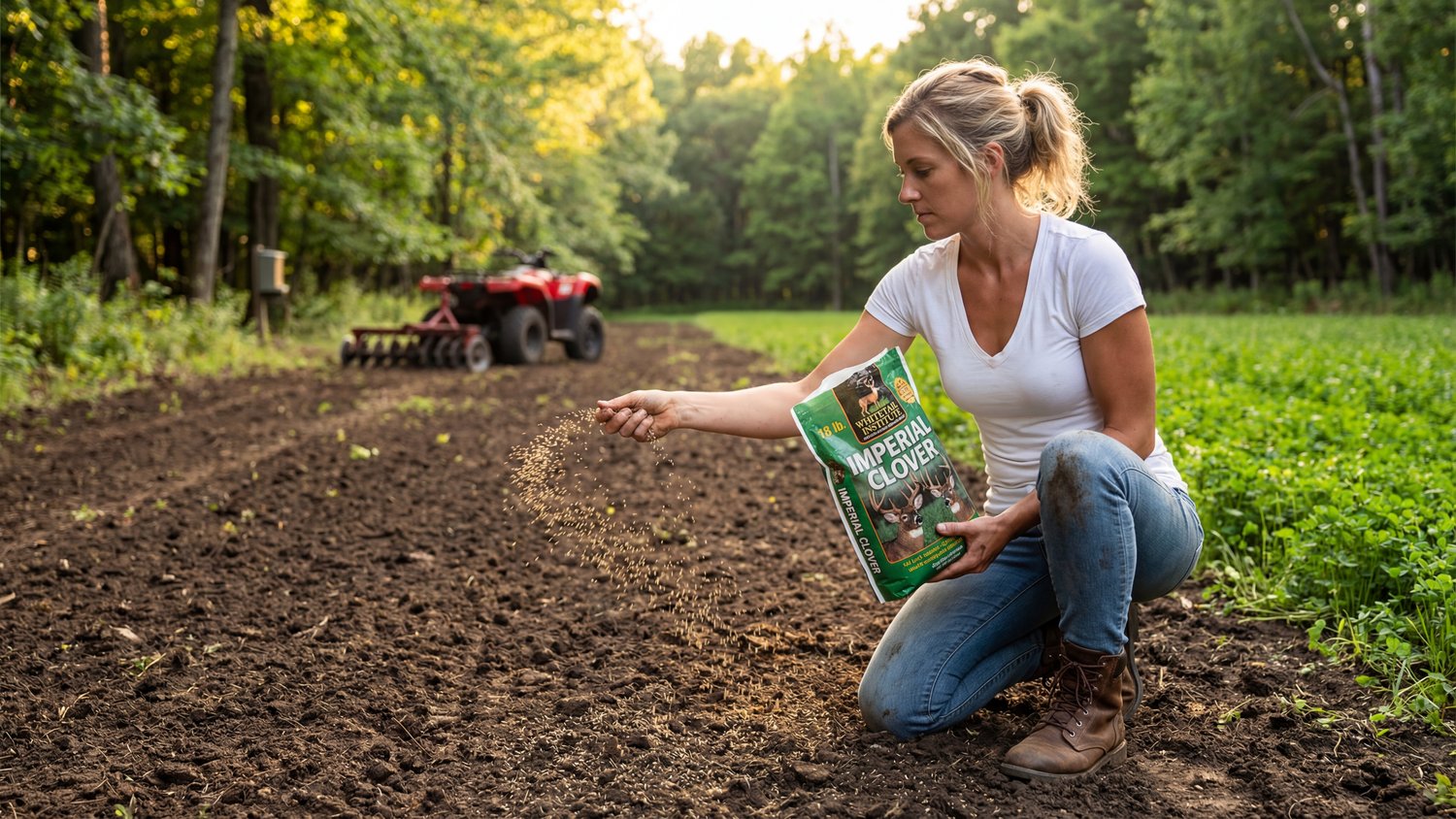
What is the best food plot seed for deer?
For year-round attraction, Durana White Clover ($33-40/acre) is the best perennial food plot seed — it persists 3-5+ years and handles heavy deer browsing. For fall hunting plots, a DIY brassica blend of purple top turnips + dwarf essex rape costs just $25-60/acre and produces massive forage after frost. For budget plotters, cereal rye from your local co-op ($25/acre) grows in almost any soil.
What is the best food plot seed for deer?
For year-round attraction, Durana White Clover ($33-40/acre) is the best perennial food plot seed — it persists 3-5+ years and handles heavy deer browsing. For fall hunting plots, a DIY brassica blend of purple top turnips + dwarf essex rape costs just $25-60/acre and produces massive forage after frost. For budget plotters, cereal rye from your local co-op ($25/acre) grows in almost any soil.
Key Takeaways
- Commodity seed from your local co-op costs a fraction of branded blends and often outperforms them
- Soil testing before planting saves more money than any premium seed blend — a $15 test prevents $200 in wasted seed
- Durana clover ($33-40/acre) is the best long-term investment — 3-5+ years from one planting with proper pH
- Evolved Throw and Gro is approximately 85% ryegrass per forum analysis — read every seed tag before buying
- A DIY brassica blend (turnips + rape) costs $25-60/acre vs $78+/acre for branded brassica products
- Real World Wildlife Products has the strongest forum reputation — no filler seeds, no excessive coating
This article contains affiliate links. As an Amazon Associate I earn from qualifying purchases. I only recommend products I've personally used.
I've been planting food plots on my own properties for over 15 years—in Indiana, Idaho, and Alaska. I've spent more money on seed than I care to admit, and I've learned that the bag with the biggest buck on the label isn't always the one that performs best in the dirt.
This guide covers the food plot seeds that have actually worked for me and the guys I hunt with. No theoretical advice from someone who's never run a disc. Just real results from real ground.
Quick Picks: Best Food Plot Seed by Situation
Short on time? Here is what to plant based on your situation:
- Best Perennial (Plant Once): Durana White Clover (~$33-40/acre) — set it and mostly forget it for 3-5 years
- Best Spring Planting: Whitetail Institute Imperial Clover (~$80-90/acre) — establishes reliably in spring, premium price
- Best Fall Planting: BioLogic NZ Maximum (~$56-70/acre) — fast-growing brassica blend, Outdoor Life #1 for the Midwest
- Best Budget Option: Crimson Clover from your local co-op (~$64-95/acre) — dirt cheap, grows almost anywhere, fixes nitrogen
- Best Cheapest-Per-Acre: DIY Brassica Blend (turnips + rape, ~$25-60/acre) — deer demolish it after first frost
- Best No-Filler Brand: Real World Wildlife Deadly Dozen (~$144/acre) — 12 species, no filler, strongest forum reputation
- Best Cereal Grain: Winter Rye + Oats from your local elevator (~$25-80/acre) — fast green-up, easiest to grow, nearly foolproof
The Co-Op Secret
Many experienced food plotters on Habitat Talk, ArcheryTalk, and Michigan Sportsman forums buy commodity seed in bulk from local farm supply co-ops and blend their own for a fraction of branded product costs. A DIY brassica blend (turnips + rape) costs $25-60/acre vs $78+/acre for branded products. Buy the co-op seed and spend the savings on soil testing and lime — your plots will outperform the expensive bag every time.
Now let me get into the details on each one.
Understanding Food Plot Seed Types
Before we talk specific products, you need to understand the major seed categories. Each type serves a different purpose, and the best food plots usually combine two or three types across your property.
Clovers
Clovers are the backbone of most food plot programs. They're high in protein (25-30%), fix nitrogen in the soil, and deer eat them from spring through fall. Perennial clovers like Durana and ladino can last 3-5 years with minimal maintenance. Annual clovers like crimson are cheaper but need replanting each year.
The downside: clover needs decent soil pH (6.0+ for most varieties) and adequate moisture. If your ground is bone dry in summer or your pH is below 5.5, clover will struggle.
Brassicas
Turnips, rape, radishes, and kale fall into this family. Brassicas are cool-season annuals that produce massive amounts of forage in a short time. Here's what most people don't realize: deer often ignore brassicas until after a hard frost converts the starches to sugars. Then they absolutely destroy them.
Brassicas are excellent for late-season hunting plots. The bulbs of turnips and radishes also break up compacted soil, which helps future plantings.
Cereal Grains
Winter wheat, oats, rye, and triticale. These are the easiest food plot seeds to grow, period. They germinate fast, tolerate poor soil, and provide green forage when everything else has gone dormant. Oats are a fall annual (winter-kills in most zones), while winter rye and wheat survive through spring.
Cereal grains don't have the protein content of clover, but they're workhorses for attraction and ease of establishment.
Chicory
A deep-rooted perennial that handles heat and drought better than clover. Chicory is high in protein and minerals, and deer love it. It's usually best as a blend component rather than a stand-alone planting. Mix it with clover for a plot that stays green when summer heat shuts clover down.
Blends
Most commercial food plot products are blends—combinations of multiple seed types designed for specific seasons or situations. Blends can be great (diversity means something is always growing) or they can be a way for companies to bulk up a bag with cheap filler seed. Read the seed tag and know what you're actually buying.
Know Your Seed Tag
Every bag of seed has a tag listing exactly what's inside by percentage. If a "premium clover blend" is 40% annual ryegrass, you're paying clover prices for cheap grass seed. Always check the tag.
Spring vs. Fall Planting Guide
Timing is probably the single biggest factor in food plot success, and it's where I see people mess up the most. Here's the breakdown:
Spring Planting (March–May)
Best seeds: Clovers, chicory, spring oats
Spring plantings work best for establishing perennial plots that you want producing for years. Frost-seeding clover in late February or March (broadcasting seed onto frozen ground and letting freeze-thaw cycles work it in) is one of the most effective and laziest methods I've ever used.
The risk with spring planting is weed competition. Warm soil sprouts weeds alongside your food plot seed, and without mowing management, weeds can choke out young clover.
Fall Planting (August–October)
Best seeds: Brassicas, cereal grains, clover, annual blends
Fall is the money season for food plots. Weed pressure drops, moisture is usually more reliable, and you're planting right before hunting season. Most annual blends are designed for fall planting because they provide maximum attraction during deer season.
The timing window matters: plant too early and brassicas bolt in the heat. Plant too late and nothing establishes before frost. In the Midwest, I target late August through mid-September for most fall blends.
The 7 Best Food Plot Seeds (Detailed Reviews)
1. Whitetail Institute Imperial Clover — Best Premium Clover Blend
Imperial Clover is probably the most recognized name in food plots — Outdoor Life ranked it #1 Best for Fall in 2026 — and for good reason: it works. This is a proprietary blend of Whitetail Ladino Clover, Crusade Clover, and Alex Berseem Clover that produces up to 35% protein and can last 3-5 years as a perennial.
I have planted Imperial on three different properties. On ground with good pH and fertility, it performs beautifully. The stand is thick, stays green into summer, and deer use it heavily from April through October. On marginal ground with low pH, it struggled just like any other clover would.
The knock on Imperial is the price — approximately $80-90 per acre at the recommended 8 lbs/acre seeding rate (2 lb bag: $21.89, 4 lb: $39.99, 18 lb: $144.99 at Seed World). That is roughly double the cost of Durana clover per acre. Forum users on ArcheryTalk also note that the product contains approximately 35% coating material, which inflates the apparent weight — you are not getting 8 lbs of pure seed in an 8 lb bag.
Pros:
- Proven performer with decades of track record — the product that "started the food plot revolution"
- Excellent deer attraction from spring through fall (up to 35% protein)
- Good longevity (3-5 years) with proper management
- Tolerates grazing pressure well
Cons:
- Premium price: ~$80-90/acre vs ~$33-40/acre for Durana
- Contains ~35% coating material by weight — inflates the bag cost per actual seed
- Slow germination allows weeds to establish before clover takes hold (multiple forum complaints)
- Needs soil pH 6.5+ for best results
- Not drought-tolerant — struggles in dry summers
Whitetail Institute Imperial Clover
Premium perennial clover blend. Plant 8 lbs per acre in prepared seedbed. 2 lb ($22) / 4 lb ($40) / 18 lb ($145).
Check Price on Amazon →2. BioLogic NZ Maximum — Best Fall Brassica Blend
Now sold under the "Mossy Oak BioLogic" branding, NZ Maximum is a 100% New Zealand brassica blend with multiple species that mature at different rates — giving you a plot that stays attractive from early fall through late winter. Outdoor Life ranked it #1 Best for the Midwest in 2026. At 36% crude protein and 80%+ TDN, the nutritional profile is excellent. Claimed forage production is 10-15 tons per acre.
I have had good luck with this blend on ground that was not perfectly prepared. The brassica components are forgiving and germinate quickly. By October you have got a lush, diverse plot that deer demolish after the first hard frost sweetens the leaves.
The catch: at ~$56-70 per acre (9 lbs/acre at $6.20-$7.75/lb depending on bag size), it costs roughly 4x what a DIY commodity brassica blend would run. Forum users on Habitat Talk are split — some say it outperforms generic brassica seeds, others say generic turnips and rape work just as well for a quarter of the cost.
Pros:
- 100% New Zealand brassicas — multiple species maturing at staggered times
- 36% crude protein, 80%+ TDN — highest nutritional profile in this comparison
- Outdoor Life #1 for the Midwest (2026)
- Fast establishment with late-season attraction after frost
Cons:
- ~$56-70/acre — roughly 4x the cost of DIY brassica blends ($15-35/acre)
- Forum consensus: soil needs to be "nearly perfect" for best results
- Annual — requires replanting every year
- Some bags reported containing unintended species (forum reports on Michigan Sportsman)
- Requires crop rotation every couple of years
Mossy Oak BioLogic NZ Maximum
100% NZ brassica blend. 2 lb ($25) / 8 lb ($62) / 40 lb ($270). Plant 9 lbs/acre in late summer.
Check Price on Amazon →3. Evolved Habitats Throw & Gro — No-Till Option (Read the Fine Print)
Not everyone has a tractor, disc, or ATV with a cultivator. If you are working with hand tools or no equipment at all, Throw & Gro is designed for exactly that situation. The concept is simple: clear the ground (spray herbicide or rake away debris), broadcast the seed, and let rain do the rest. At $12.99-$18.29 per 5 lb bag (Fleet Farm / Shell Lumber), it is one of the cheapest branded options.
Does it work? Yes, but with serious caveats. I have used Throw & Gro on small clearings in timber where getting equipment in was not practical. On bare mineral soil with decent moisture, germination was solid. On thick leaf litter or heavy grass, results were spotty.
Here is what the research uncovered that most buyers do not know: Multiple forum analyses on ArcheryTalk and Michigan Sportsman report that Throw & Gro is approximately 85% tetraploid ryegrass with token amounts of clover and brassica. Several users describe the result as "basically just grass" and report deer ignoring it to feed elsewhere. Some users also warn that ryegrass can become invasive and hard to eradicate once established.
That said, positive reviews exist too — some users report deer "mowed it down like a golf course by mid-November." Results appear highly dependent on soil, moisture, and region. Read the seed tag on your specific bag before buying.
Pros:
- No equipment needed — truly broadcast and walk away
- Cheapest branded option at $13-18 per bag
- Works well in small woodland openings
- Good germination on bare or disturbed soil
Cons:
- Forum analysis says ~85% ryegrass with token clover/brassica — "basically just grass"
- Ryegrass can be invasive and difficult to remove once established
- Very inconsistent germination rates reported (Walmart reviews)
- ~$52-72/acre at 20 lbs/acre — commodity ryegrass costs a fraction of this
- Annual blend — replant yearly
Evolved Habitats Throw & Gro
No-till blend. 5 lb bag covers 0.25 acre. $13-18 per bag. Also available as X-treme (with radish) and Xtreme Oats variants.
Check Price on Amazon →4. Crimson Clover — Best Budget Option
Crimson clover is the working man's food plot seed. At $3.20-$4.75 per lb retail (~$160/50 lb bag from Seed World) and 20-26 lbs/acre planting rate, you can seed several acres for what one bag of premium blend costs. It grows in poor soil, fixes nitrogen, and deer eat it.
I use crimson clover as a soil builder. Plant it in fall, let it grow through spring, and it adds nitrogen and organic matter to the soil. The following year, that ground is in much better shape for planting perennial clover or a premium blend. It's also a legitimate food source—deer browse it from early spring until it flowers out in late spring.
The main limitation is that it's an annual. It grows through winter and spring, then dies in summer. You'll need to replant or rotate to something else. But at the price point, that's not a hardship.
Pros:
- Extremely affordable—fraction of the cost of premium blends
- Tolerates poor soil and lower pH (5.5+)
- Fixes nitrogen and builds organic matter
- Easy to establish with minimal prep
- Deer forage on it heavily in early spring
Cons:
- Annual—dies in summer, must replant each fall
- Not a summer food source
- Lower protein than perennial clovers
Crimson Clover Seed
Annual clover, great for building soil and providing spring forage. Plant 15-20 lbs per acre in early fall.
Check Price on Amazon →5. Brassica Blend (Purple Top Turnips + Rape) — Best Late Season
If you hunt late season, you need brassicas. Period. Nothing else pulls deer like turnips and rape after a couple hard frosts. I've watched deer dig turnip bulbs out of frozen ground in December—they're that attracted to them.
A simple blend of purple top turnips (~$1.89-$2.47/lb, 8-10 lbs/acre) and dwarf essex rape (~$1.00-$3.50/lb, 8-10 lbs/acre) gives you the best of both worlds for just $25-60/acre total — a fraction of what branded brassica blends cost. Turnips provide 100% consumable bulbs and leafy tops, while rape produces huge amounts of leafy forage with 18-20% crude protein. Plant this in late summer and by hunting season you will have a plot that looks like a salad bar.
The key thing to understand about brassicas is the frost factor. Early in the season, deer may walk right past your brassica plot. Don't panic. Once temperatures drop and starches convert to sugars, those same deer will be in there every evening. Patience.
Pros:
- Incredible late-season attraction after frost
- Produces massive forage tonnage in a short growing window
- Turnip bulbs break up compacted soil
- Easy to grow—brassicas are very forgiving
- Affordable seed costs
Cons:
- Deer may ignore them until after frost—plan your timing accordingly
- Annual—replant every year
- Can develop a strong smell as they decompose (some hunters dislike this)
- Need to be planted in late summer for best results
Purple Top Turnip Seed
Classic late-season brassica. Plant 3-5 lbs per acre in late summer. Deer hammer the bulbs and tops after frost.
Check Price on Amazon →Dwarf Essex Rape Seed
High-forage brassica for fall plots. Plant 5-8 lbs per acre. Combine with turnips for a complete brassica plot.
Check Price on Amazon →6. Winter Rye + Oats Mix — Best Cereal Grain Plot
This is the combination I recommend to every new food plotter. Winter rye and oats together give you the fastest, easiest, most forgiving food plot you can plant. Oats germinate in 5-7 days and provide immediate green forage. Winter rye establishes more slowly but survives winter and provides spring forage after the oats winter-kill. Forum users call cereal rye "the poor man's food plot crop" — and they mean it as a compliment.
I plant this mix on every property I manage. It is my go-to for new ground where I have not soil tested yet, for plots where I am rotating out of clover, and for any situation where I need a guaranteed stand of green. Cereal grains will grow in soil that would kill clover.
Mix about 50-60 lbs of oats (~$0.60-$1.00/lb) with 50-60 lbs of winter rye (~$0.35-$1.00/lb) per acre. Your local elevator or co-op is almost always the cheapest source — typically $17-20 per 56 lb bushel for rye and $27-30 per 48 lb bag for oats. Total cost: approximately $25-80/acre depending on your source. Mississippi State Extension data shows cereal rye costs $31.46 per 1,000 lbs of deer forage vs oats at $37.76 — making rye the better value of the two. Broadcast and lightly cover (drag, cultipack, or even drive over it with an ATV). You will have green in a week.
Pros:
- Easiest food plot seed to establish—nearly foolproof
- Fast germination (oats up in 5-7 days)
- Grows in poor soil and lower pH
- Winter rye survives through spring for extended forage
- Very affordable
- Great for breaking new ground or rotating tired plots
Cons:
- Lower protein than clover (12-16% vs. 25-30%)
- Annual—oats winter-kill, rye goes to seed in spring
- Not as "attractive" to deer as clovers or brassicas in some situations
- Can get rank and stemmy if not managed
Winter Rye Seed (50 lb)
Hardy cereal grain that survives winter and provides spring forage. Plant 50-60 lbs per acre in fall.
Check Price on Amazon →Oat Seed for Food Plots
Fast-growing annual. Germinates in days. Mix with winter rye for a complete cereal grain plot. 50-60 lbs per acre.
Check Price on Amazon →7. Durana White Clover — Best Perennial Stand-Alone
If I could only plant one food plot seed for the rest of my life, it would be Durana. Developed by the University of Georgia, this patented ladino-type white clover was specifically engineered for grazing pressure tolerance and acidic soil tolerance. It spreads by stolons (runners), fills in gaps, and persists up to 3x longer than conventional ladino varieties. At 25% protein and 75%+ digestibility, the nutritional profile is solid. Pennington Rackmaster is the hunting/wildlife-marketed version — same genetics.
I have a Durana plot that has been producing for four years now with nothing more than an annual mowing and occasional fertilizer. The stand is thick, deer use it from green-up through hard frost, and it looks better each year as it fills in.
At ~$33-40 per acre (5 lbs/acre at $6.54-$8.00/lb — Seed World has 5 lb bags at $47.77), Durana is the best long-term value on this list. Compare that to Imperial Clover at $80-90/acre. The catch: Durana demands good soil prep. pH needs to be 6.0 or higher — 6.5 is better. It needs phosphorus and potassium. And critically: do NOT plant deeper than 1/8 inch. Many stand failures come from planting too deep. The seed is sold preinoculated with lime coating and Rhizobia, so no separate inoculant is needed.
Pros:
- Exceptional longevity—3-5+ years with proper care
- Spreads via stolons, filling in bare spots naturally
- Handles heavy deer grazing better than other clovers
- High protein content (25-28%)
- More drought-tolerant than standard ladino
- Plant once, maintain minimally for years
Cons:
- Requires soil pH 6.0+ (6.5 ideal)
- Slow to establish compared to annuals—patience needed first year
- Higher seed cost than commodity white clover ($6.54-$8/lb vs ~$4-5/lb generic)
- Do NOT plant deeper than 1/8 inch — this is the #1 cause of stand failure
- Needs proper seedbed preparation — no shortcuts
Durana White Clover Seed (Pennington Rackmaster)
University-developed perennial clover. Plant 5 lbs per acre, no deeper than 1/8 inch. 5 lb bag ~$48.
Check Price on Amazon →Honorable Mention: Real World Wildlife Deadly Dozen
Real World Wildlife Products was founded by hunters frustrated with existing products and deceptive marketing. Their philosophy: no filler seeds, no excessive seed coating. They even offer a side-by-side challenge — buy a competitor's product and plant it next to theirs.
Deadly Dozen is a 12-species fall blend: Winter Hardy Oats, Winter Wheat, Winter Barley, Austrian Winter Peas, Tillage Radish, Purple Top Turnips, Rape Plus, Sugar Beets, Forage Collards, Impact Forage Collards, Crimson Clover, and Oil Seed Radish. Plant approximately 45 days before first frost.
The catch is price: at 50 lbs/acre and $35.99 per 12.5 lb bag (covers 0.25 acre), you are looking at ~$144/acre. That is the most expensive option in this comparison by a wide margin. But forum users on Habitat Talk and ArcheryTalk report it outperforms Imperial Clover in side-by-side tests, and the brand has the strongest cult following of any seed company among serious habitat managers.
Pros: No filler seeds, no excessive coating, 12-species diversity, strongest forum reputation
Cons: ~$144/acre is the highest cost in this comparison. Only available in 0.25-acre bags — for larger plots, buy their component products (Harvest Salad 50 lb, Plot Topper 3 lb).
Real World Wildlife Deadly Dozen
12-species fall blend, no filler. 12.5 lb bag covers 0.25 acre (~$36). Plant 45 days before first frost.
Check Price on Amazon →Cost Per Acre: The Real Comparison
This is the table most seed companies do not want you to see. When you compare cost per acre rather than cost per bag, the value picture changes dramatically:
| Seed | Cost/Acre | Rate | Type |
|---|---|---|---|
| Egyptian Wheat (screening) | $6-17 | 4-10 lbs/acre | Screening cover |
| Dwarf Essex Rape | $10-35 | 8-10 lbs/acre | Annual brassica |
| Purple Top Turnips | $15-25 | 8-10 lbs/acre | Annual brassica |
| Cereal Rye (co-op) | $25-80 | 70-80 lbs/acre | Cereal grain |
| Durana Clover | $33-40 | 5 lbs/acre | Perennial clover |
| Oats (co-op) | $48-100 | 100 lbs/acre | Cereal grain |
| Evolved Throw & Gro | $52-72 | 20 lbs/acre | Annual blend |
| BioLogic NZ Maximum | $56-70 | 9 lbs/acre | Annual brassica |
| Crimson Clover | $64-95 | 20-26 lbs/acre | Annual clover |
| WI Winter-Greens | ~$78 | 6 lbs/acre | Annual brassica |
| WI Imperial Clover | $80-90 | 8 lbs/acre | Perennial clover |
| Real World Deadly Dozen | ~$144 | 50 lbs/acre | Annual blend |
Bottom line: Durana clover gives you the best value for a perennial plot that lasts 3-5+ years. For fall annuals, a DIY brassica blend (turnips + rape) costs $25-60/acre vs $56-144/acre for branded products. Buy commodity seed from your local co-op and spend the savings on lime and proper soil amendments — your results will be better than the expensive bag every time.
Food Plot Seed Comparison Table
| Seed | Type | Planting Season | Seeding Rate | Min pH | Lifespan |
|---|---|---|---|---|---|
| Imperial Clover | Clover Blend | Spring / Late Summer | 8 lbs/acre | 6.5 | 3-5 years |
| Biologic Maximum | Annual Blend | Late Summer | 10 lbs/half-acre | 5.8 | 1 season |
| Throw & Gro | No-Till Blend | Spring / Fall | Varies by bag size | 5.5 | 1 season |
| Crimson Clover | Annual Clover | Early Fall | 15-20 lbs/acre | 5.5 | 1 season |
| Turnips + Rape | Brassica Blend | Late Summer | 3-5 + 5-8 lbs/acre | 5.8 | 1 season |
| Winter Rye + Oats | Cereal Grains | Late Summer / Fall | 100-120 lbs/acre (mixed) | 5.0 | 1 season (rye overwinters) |
| Durana Clover | Perennial Clover | Spring / Late Summer | 4-6 lbs/acre | 6.0 | 3-5+ years |
Soil Prep Basics: The Foundation of Every Good Plot
I don't care what seed you buy—if your soil isn't right, it won't perform. Here's the minimum you need to do:
1. Test Your Soil
A soil test costs about $15 from your county extension office. It tells you your pH, phosphorus, potassium, and organic matter levels. This isn't optional—it's the single most important step in food plot management. I wasted hundreds of dollars on seed before I started testing, and I kick myself every time I think about it.
Soil Test Kit
Basic soil testing kit for pH, nitrogen, phosphorus, and potassium. Your county extension office also does detailed tests for a small fee.
Check Price on Amazon →2. Lime If Needed
Most woodland and pasture soils in the eastern US run acidic (pH 5.0-5.5). Clover wants 6.0-6.5. That means lime. Apply pelletized lime at rates your soil test recommends—typically 1-2 tons per acre for moderately acidic soil. The critical thing to know: lime takes 3-6 months to fully react. Apply it well before your planting date.
3. Prepare the Seedbed
For conventional plots, disc or till the top 3-4 inches to create loose soil. Broadcast your seed, then cultipack or drag to ensure seed-to-soil contact. Small clover seed should be no more than 1/4 inch deep. Cereal grains can go 1-2 inches deep.
No-Till Alternative
If you don't have equipment, no-till is absolutely viable. Spray existing vegetation with glyphosate, wait for it to die, then broadcast seed into the dead residue. Mow or trample the dead vegetation down first for better seed contact. No-till works particularly well with cereal grains and brassicas. Pure clover is trickier no-till because the seed is so small.
Lime Tip
Pelletized lime is easier to spread with a hand spreader, but agricultural lime (ground limestone) is cheaper per ton if you're doing multiple acres with a tractor-mounted spreader. Both work—pelletized just reacts slightly faster.
Plot Size Recommendations
Bigger isn't always better, but too small is a real problem. Here's my general guidance:
- Minimum plot size: 1/4 acre for clover, 1/2 acre for brassicas and cereal grains. Anything smaller gets browsed to dirt before it can establish.
- Ideal for hunting plots: 1/2 to 1 acre. Big enough to sustain browsing pressure, small enough that deer feel comfortable using it during daylight.
- Ideal for nutrition/herd health: 2-5 acres. If your goal is supplemental nutrition rather than hunting over a plot, go bigger. More forage means more carrying capacity.
- Multiple small plots beat one big one. Three half-acre plots spread across your property give deer more options and give you more stand locations than one 1.5-acre plot.
If deer browsing pressure is extreme (small property, lots of deer), consider running temporary electric fence around new plantings for 4-6 weeks to let them establish before deer hammer them.
Common Food Plot Mistakes
I've made every one of these. Learn from my failures.
1. Skipping the Soil Test
I've said it three times already and I'll say it again. The difference between a plot that produces and a plot that fails is almost always soil chemistry. Test your dirt.
2. Planting Too Late
Fall plots need time to establish before frost. In the Midwest, planting brassicas in October is too late. You need 45-60 days of growing time before hard frost. Back your planting date up from your average first frost date.
3. Wrong Seed for Your Soil
Planting clover in 5.0 pH soil without lime is throwing money away. If your soil is poor and you can't amend it yet, start with cereal grains or crimson clover—they're much more tolerant of bad conditions.
4. No Weed Management
New food plots compete with weeds. In spring-planted clover, mow at 8-10 inches tall to clip weeds above the clover canopy. The clover stays low; the weeds don't. This single management step makes a massive difference in first-year establishment.
5. Planting the Same Thing Every Year
Rotating between seed types keeps soil healthy and breaks up pest and disease cycles. Follow a clover plot with cereal grains, then brassicas, then back to clover. Your soil will thank you.
6. Broadcasting Without Soil Contact
Throwing seed on top of grass or heavy residue and hoping for the best is the biggest waste of money in food plotting. If the seed can't touch mineral soil, it can't germinate. Kill the existing vegetation, get seed into or onto bare dirt, and pack it.
7. Buying Too Little Seed
Thin stands get overwhelmed by weeds. Use the full recommended seeding rate. Going a little heavy is better than going light. The cost difference between a sparse, weedy plot and a thick, productive one is often just a few extra pounds of seed.
Frequently Asked Questions
What is the best food plot seed for deer?
There's no single best seed—it depends on your goals, soil, and season. For a perennial plot that produces for years, Durana white clover is hard to beat. For fall hunting plots, a brassica and cereal grain blend provides the most attraction during deer season. For beginners or poor soil, winter rye and oats is the most forgiving option.
When should I plant food plots for deer?
Fall planting (late August through September in the Midwest) is ideal for most food plot seeds. You get lower weed pressure, more reliable moisture, and you're planting right before hunting season. Spring planting works well for establishing perennial clover, with frost-seeding in late February to March being especially effective.
How big should a food plot be?
Minimum 1/4 acre for clover, 1/2 acre for brassicas and cereal grains. Sweet spot for hunting plots is 1/2 to 1 acre. For nutritional plots, 2-5 acres. Multiple smaller plots beat one large plot for both hunting and deer movement.
Do I need to till for food plots?
Not necessarily. No-till methods work well for cereal grains and brassicas—spray existing vegetation with herbicide, then broadcast seed into the dead residue. Clover is trickier no-till because the seed is tiny and needs firm soil contact. Conventional tillage gives the most consistent results for clover, but no-till is absolutely viable if you can't get equipment to your plot.
What pH does clover need?
Most clovers want a pH of 6.0 or higher, with 6.5 being ideal. If your soil tests below 6.0, apply lime according to your soil test recommendations 3-6 months before planting. Crimson clover is more tolerant of lower pH (5.5+) and can serve as a soil-building crop while you raise pH for future perennial clover plantings.
Can I mix different food plot seeds together?
Yes, and you should. Diversity is good for food plots. Classic combinations include clover + chicory for perennial plots, oats + winter rye for cereal grain plots, and turnips + rape + oats for fall hunting blends. Just make sure all the seeds in your mix have similar planting depth and timing requirements.
How long does food plot seed last in storage?
Most food plot seed stored in a cool, dry place maintains good germination rates for 2-3 years. Clover and brassica seed tends to hold up well. Cereal grains (oats, rye, wheat) should ideally be planted the year you buy them. Always check germination rates if using older seed—plant a test batch in a damp paper towel before committing a whole plot.
The Bottom Line
The best food plot seed is the one you actually plant in prepared soil at the right time. I have seen guys with $20 worth of crimson clover outperform guys with $200 worth of premium blends — because the cheap seed went into limed, fertilized soil with a good seedbed, and the expensive seed got thrown on top of unprepared ground.
Here is my advice after 15+ years of food plotting: Start simple. Get a soil test. Fix your pH. Plant winter rye and oats from your local co-op your first fall to get something green in the ground and build confidence. Then transition to clover or blends on your best plots as you learn your soil and your deer patterns. Check our planting calendar for timing by region.
When you are ready to spray herbicide and fertilizer on your plots, see our ATV sprayer guide for equipment recommendations. And for the big-picture approach to food plot placement and plot shape design, check our hunting property design hub.
The deer do not read the seed bag. They just eat what is green, nutritious, and available. Give them that, and they will show up.
Food Plot Planting Checklist
- Test soil pH and nutrient levels (lime takes 6+ months to work)
- Kill existing vegetation with glyphosate 2-3 weeks before planting
- Disc or till seedbed to 4-6 inch depth
- Broadcast seed at recommended rate — more is not better
- Cultipack or drag to ensure seed-to-soil contact
- Apply starter fertilizer based on soil test results
- Fence or protect new plantings from over-browsing first 60 days
- Monitor germination at 7 and 14 days
- Plan fall overseeding dates for perennial plots
