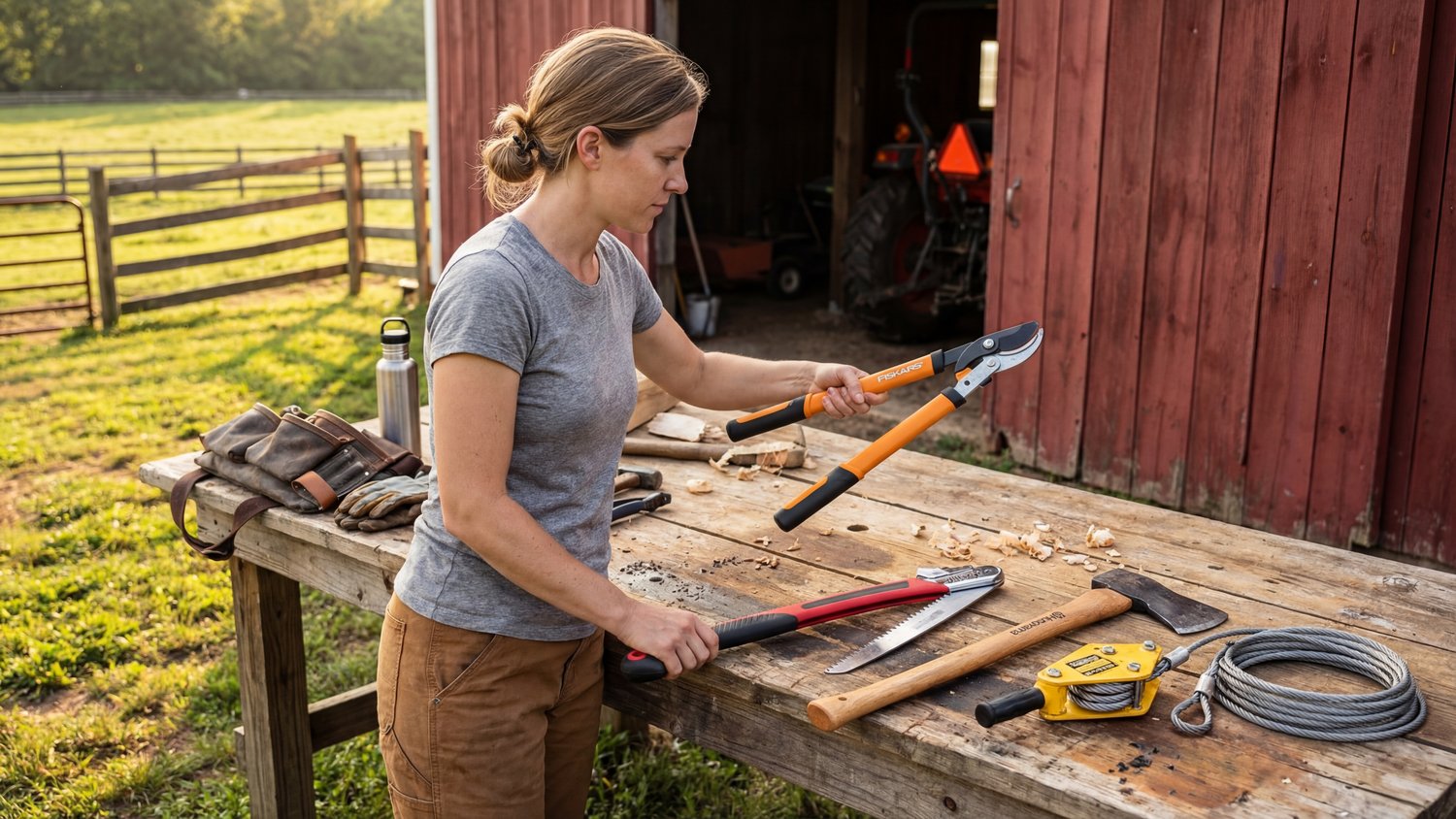
What hand tools does a rural landowner actually need?
Start with these six: Fiskars PowerGear2 bypass loppers (~$40, 3X cutting power), a Silky Gomboy folding saw ($58-70, arborist-grade), Channellock 85 fence pliers (~$40, 6-in-1 fencing multi-tool), a Maasdam 2-ton come-along (~$64, lifetime warranty, USA-made), a Bully Tools 14-gauge shovel ($48-60, won't break when you pry), and a Tramontina bolo machete (~$16-20) for trail clearing. Total: roughly $250-295 for tools that last a decade.
What hand tools does a rural landowner actually need?
Start with these six: Fiskars PowerGear2 bypass loppers (~$40, 3X cutting power), a Silky Gomboy folding saw ($58-70, arborist-grade), Channellock 85 fence pliers (~$40, 6-in-1 fencing multi-tool), a Maasdam 2-ton come-along (~$64, lifetime warranty, USA-made), a Bully Tools 14-gauge shovel ($48-60, won't break when you pry), and a Tramontina bolo machete (~$16-20) for trail clearing. Total: roughly $250-295 for tools that last a decade.
Key Takeaways
- Loppers + pruning saw is the combo you'll use more than anything except a chainsaw — carry both on the ATV
- The Fiskars PowerGear2 gear mechanism delivers 3X cutting force — 2" branches feel like butter
- Maasdam come-along ($64) is the industry standard for 50+ years — avoid budget brands that fail near rated capacity
- Bully Tools shovels are the #1 pick from both The Spruce and Wirecutter — 14-gauge steel won't flex or split on rocks
- A $16 Tramontina machete clears 200 feet of trail in the time it takes to walk it — most underrated property tool
- Channellock 85 fence pliers ($40) do 6 jobs in one tool — farmers report 20+ years of use with zero failures
This article contains affiliate links. As an Amazon Associate I earn from qualifying purchases. I only recommend products I've personally used.
The hand tools that get used constantly on rural property: cutting, digging, fastening, and fixing the stuff that always breaks. Big equipment handles the big jobs. Hand tools handle everything else--which is about 90% of the actual work.
The difference between a productive Saturday on the property and a frustrating one usually comes down to whether you can find the right hand tool and whether it's worth a damn when you do. Buy quality once, store it where you work, and stop rebuying cheap stuff that breaks when you need it most.
The Real Test
If a tool hasn't come off the shelf in a year, sell it or give it away. If you reach for something weekly, buy the best version you can afford. Rural property has a way of sorting tools into "essential" and "decoration" fast.
Loppers vs Pruning Saws: Know the Difference
Loppers and pruning saws both cut branches, but they're not interchangeable. Loppers are for green wood up to about 2 inches. They use leverage to make clean cuts through live growth — perfect for trail maintenance, clearing shooting lanes, and trimming around food plots. Bypass loppers cut cleaner than anvil style on live wood.
Pruning saws pick up where loppers leave off. A good folding pruning saw handles 2-5 inch branches that would destroy loppers. For habitat work, you'll use a pruning saw constantly: clearing fallen limbs, trimming hinge cuts, opening up trails. A saw with aggressive teeth cuts green and dry wood equally well.
The move is to carry both. Loppers on the ATV, pruning saw on your belt. You'll use them more than any other cutting tool except the chainsaw.
Fiskars PowerGear2 Bypass Loppers (32") — ~$40-48
3X cutting power via modified gear mechanism. Cuts up to 2" branches. 3.9 lbs, fully hardened bypass steel with low-friction coating, SoftGrip handles. Lifetime warranty. Outdoor Life "Best for Big Branches" pick. Also available in 18" and 25" versions.
Check Price on Amazon →Silky Gomboy Folding Pruning Saw (240mm) — $58-70
Japanese-made, 9.45" chrome-plated blade, cuts up to 4.7" branches. 0.63 lbs, folds to 10.63". Impulse-hardened triple-edge teeth (10 per 30mm). BBC Gardeners\' World "Best Buy." Arborist community standard. The Outback Edition (thicker blade) is recommended for property work over the standard garden version.
Check Price on Amazon →The Right Axe or Hatchet
You don't need a collection. You need one good hatchet and one splitting axe, and you need to keep them sharp.
A hatchet rides on the ATV or in the truck for small jobs: splitting kindling, driving stakes, knocking apart pallets, cutting small roots. A 1.5 to 2 pound head with a 14-16 inch handle is the sweet spot. Light enough to swing one-handed, heavy enough to do actual work.
A splitting axe is for firewood and larger root work. The maul-style heads with a wider profile split wood more efficiently than a thin axe head. If you heat with wood or process timber for any reason, a 6-8 pound splitting axe saves enormous time over a standard axe.
Husqvarna 26-Inch Multipurpose Axe — $134.99
Hand-forged Swedish steel head (1.9 lbs), 26" curved American hickory handle, 2.7 lbs total. Full-grain leather edge cover included. Head attached with both wooden and steel wedge. BladeForums: "wonderfully balanced." Compared to Gransfors Bruks at ~$200+ — "performs just as well for half the price."
Check Price on Amazon →Come-Along and Hand Winch
A come-along is one of those tools that sits unused for months and then becomes the most important thing you own. Hung-up trees, stuck ATVs, tensioning fence wire, pulling posts--a 2-ton come-along handles all of it.
The trick is buying one that actually works when you need it. Cheap come-alongs seize up, strip gears, and can't hold tension. Spend the extra $20-30 on one with a quality ratchet mechanism and rated capacity you trust.
Keep a 20-foot tow strap with it. The come-along provides the pulling force; the strap provides the reach. Together they'll get you out of most stuck situations without calling for help.
Maasdam Pow\'R Pull 2-Ton Come-Along — ~$64
4,000 lb capacity, 12 ft galvanized aircraft-quality cable, 30:1 leverage ratio. 8.75 lbs. Dual-gear ratchet, high-strength electro-plated steel. Made in USA. Lifetime warranty. 4.4/5 stars (459 reviews). The industry standard for 50+ years. Unlike cheaper brands, "safely handles weight at its rated capacity."
Check Price on Amazon →Measuring and Marking
A 100-foot tape measure and a pocket full of flagging tape solve more problems than you'd expect. Laying out food plot shapes, measuring setback distances, marking property lines for a surveyor, flagging trails, marking trees for hinge cutting — the combination of "how far" and "mark it" comes up constantly.
Flagging tape is disposable and cheap. Buy it in multiple colors: one for property boundaries, one for trees to cut, one for trail markers. It's visible from a distance, and it tears off easily when you're done.
Keson 100-Foot Fiberglass Tape Measure — ~$22-35
Open reel, 40,000-strand fiberglass (doesn\'t stretch like cloth or change with temperature). Feet/inches/1/8ths graduation. Made since 1968. UV-resistant. Note: some recent quality concerns reported — check handles before heavy use. Also consider Milwaukee or Lufkin 100-ft fiberglass as alternatives with reportedly better recent build quality.
Check Price on Amazon →Machete for Trail Clearing
A machete is the most underrated trail tool. It handles the stuff that's too small for a chainsaw and too thick for loppers: briars, saplings, vines, and the general green wall that grows across any trail you stop maintaining for a month.
A 14-18 inch blade is the right size range. The Tramontina bolo at 14.5" is ideal for tight spaces and one-handed work, while their 18" Latin-style machete gives more reach in open brush. The bolo's weight-forward tip concentrates chopping force without adding arm fatigue. Keep it sharp — a dull machete is just an expensive stick that makes you tired. It ships dull, so hone it before first use.
For multiflora rose and thick briar patches, nothing beats a machete. You can clear a 200-foot trail section in the time it takes to walk it. Try that with loppers.
Tramontina 14.5-Inch Bolo Machete — ~$16-20
SAE 1070 high-carbon steel, 14.5" blade (19.5" overall), 15 oz. Hardwood handle, flat grind. Made in Brazil. 9.56/10 aggregate review score. BladeForums: "best machete you can get for the price." Weight-forward bolo design "goes through thick brush like butter." Ships dull — needs honing before first use.
Check Price on Amazon →Fencing Tools
If you have fence, you have fence repairs. It's not a matter of if, it's a matter of how often. A basic fencing toolkit saves you from making a trip to town every time a tree falls on the wire or a post rots out.
The essentials: fence pliers (the multi-tool of fencing--they cut, grip, hammer, and pull staples), a fence stretcher for tensioning wire, and a post driver for T-posts. Fence pliers alone handle 80% of quick repairs. The stretcher and driver handle the other 20%.
Keep fencing supplies on hand too: a roll of wire, a box of clips, some T-posts, and fence staples. When a tree drops on your fence at 6 AM and the cows are looking at the gap, you don't want to wait for the farm store to open.
Channellock 85 Fence Tool Pliers — ~$40-48
10.38", 1.46 lbs. 6-in-1: laser heat-treated wire shears, hammer/staple starter, hand-polished staple claw, wire stretcher, crimping nest, wire splicer. High-carbon U.S. steel, CHANNELLOCK BLUE comfort grips. 100% USA made. CattleToday ranching forum: "done fine for 20+ years of fence work."
Check Price on Amazon →T-Post Driver (12-20 lb) — $30-80
For most landowners, a 12-17 lb driver is the sweet spot. Heavier (20-34 lb) drivers pound posts faster but cause fatigue much quicker. Look for: welded (not crimped) top plate, proper handles at the right height, and powder coat to prevent rust. The Insaga 20LB model is well-reviewed for non-slip ergonomic handles and double-reinforced welded top plate.
Check Price on Amazon →The Bow Saw: Quiet and Effective
A 21-inch bow saw handles 4-6 inch wood without noise, fuel, or maintenance. During hunting season, when you need to clear a shooting lane or open a trail without alerting every deer in the county — understanding how pressure changes deer movement — the bow saw is your friend.
It's also the backup when your chainsaw won't start, which happens more often than chainsaw manufacturers would like to admit. A bow saw with a sharp blade cuts surprisingly fast for a hand tool, and replacement blades are a few dollars.
Storage Tip
Keep a set of hand tools on your ATV or in the bed of your truck at all times. A pruning saw, loppers, fence pliers, flagging tape, and a multi-tool handle 90% of what you encounter on the property. The tools in the shed don't help when you find a problem a mile from the barn.
Bahco Ergo 21-Inch Bow Saw — ~$33
High-quality steel frame with Ergo handle and knuckle protector. Quick-release blade changes. Innovative tensioning mechanism for high blade tension and straight cutting. Made in Portugal. "Much better quality than typical department store saws." Choose Type 51 blade for dry wood, Type 23 for green wood. Also available in 24" and 30".
Check Price on Amazon →Digging Tools That Don't Break
A mattock (or grub hoe) and a solid shovel cover all the digging you'll do. The mattock handles roots, rocky soil, and the hard-packed clay that a shovel bounces off of. The shovel handles everything else.
Don't buy a shovel with a wooden handle and a stamped steel blade. It'll break the first time you pry with it--and you will pry with it. Get a fiberglass handle or solid steel with a forged blade. It costs more. It also lasts 10 years instead of 10 months.
Bully Tools 14-Gauge Round Point Shovel — $48-60
14-gauge steel blade (11.5" x 9.5"), triple-wall fiberglass handle with wood-reinforced core, I-beam welded construction. 100% USA made since 1994. Lifetime warranty. 4.67/5 stars. Named "Best Shovel" by both The Spruce and Wirecutter (NYT). "Thick steel blade can pry against rock with no flex or tip splitting."
Check Price on Amazon →The Bottom Line
Hand tools aren't exciting. Nobody posts their fence pliers on social media. But they're what you actually use, day after day, to keep your property functional. Buy the good versions, store them where you work, keep them sharp, and they'll outlast anything with an engine.
For the bigger jobs these tools can't handle, see our chainsaw safety gear guide and equipment that earns its keep. And for a year-round plan of when to use all this gear, check the seasonal planning guide.
Frequently Asked Questions
The essential landowner hand tool kit includes: a quality axe or hatchet, a folding pruning saw, fencing pliers, a digging bar or pry bar, a machete or brush hook, a quality tape measure (100-foot), and a soil probe. These tools handle 90 percent of daily property tasks from clearing trails to repairing fence to testing soil. Buy quality once rather than replacing cheap tools every season.
A brush hook is better for clearing thick saplings and brush because its weight and curved blade generate more cutting force per swing. A machete is better for light vegetation, vines, and grass because it is lighter and faster to swing repeatedly. For heavy property clearing, use a brush hook. For trail maintenance and light cleanup, use a machete. Most landowners end up owning both.
A digging bar. This 5 to 6-foot steel bar pries rocks, loosens compacted soil, breaks up hardpan, sets fence posts in rocky ground, and serves as a lever for moving logs and stumps. Nothing else in your tool collection can match its combination of brute force and simplicity. The second most underrated tool is a quality 100-foot tape measure for planning food plots, fence runs, and building projects.
